Search this blog for other interesting articles

Showing posts with label background job. Show all posts

Saturday, 19 March 2016

Process to be followed to identify tables that are accessed by a background job or abap program

This article answers following queries:


  • How to identify database tables that are being accessed by a given ABAP program?
  • How to identify underlying database tables for a given background job?
  • Process to be followed to identify tables that are accessed by an ABAP program?
  • Process to be followed to identify tables that are accessed by a background job?
  • How to identify ABAP program for a given SAP background job?

==================================================


In real time, we may face several scenarios like

i)             Background job is processing slow
ii)            ABAP program is taking long time to complete execution
iii)           Log_dir is getting full very fast

In the above cases, Basis team should closely work with database teams and may have to identify the reasons behind them to resolve the issues.

Example1: If background job (or an ABAP program) is taking more time to complete, one of the reasons could be statistics for underlying database tables that this job is accessing were not up to date. We may have to run statistics to fix the performance issue.
Here we need to know which database table(s) is/are being accessed by job/abap program.

Example2: If a background job is running for long duration and log_dir at Operating System level is reaching very high levels (ex: crossing 60% usage), then the reason could be there is an issue with underlying abap program. If single or multiple processes running for long time without commiting work to the database, log hold up will happen and log_dir usage will increase. If it crosses 70%, SAP system will face performance issues and if it reaches 100%, system wouldn’t be accessible.

To resolve this issue, developers need to modify ABAP program & make sure there are frequent commit statements. In this case also, database team may request us to provide list of tables that are being accessed by this job or program.

So, in this article I’m covering that process of identifying database tables that are being accessed by an ABAP program or a background job.
First of all, I will cover the process of identifying underlying ABAP program for a given background job. Let us say you want to identify, underlying program for SAP standard job BI_WRITE_PROT_TO_APPLLOG.


Goto SM37 transaction code and provide name of the job you would like to find abap program for and execute the same:


It results in below screen:
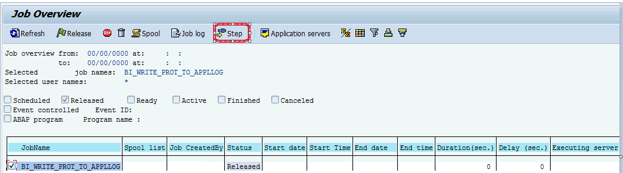


In the above screen, select the job and click on step icon (highlighted) which results in below screen


RSBATCH_WRITE_PROT_TO_APPLLOG is the underlying abap program for the given background job BI_WRITE_PROT_TO_APPLLOG. Similarly, we can identify program for any background job.

Now, our next task is to identify database tables that are being accessed by RSBATCH_WRITE_PROT_TO_APPLLOG program or BI_WRITE_PROT_TO_APPLLOG job.


Go to SE38 transaction and provide program name:


In the same screen, navigate to Utilities -> Environment Analysis as shown below


It will result in below screen.


As we need only database tables, please deselect all ticked options by clicking highlighted icon and select only database table check box and execute (as shown below).


It will result in below screen, which lists the database tables that are being accessed by this program.


This is the process to identify database tables for a given background job or an ABAP program.


Monday, 6 July 2015

How to prevent SAP background jobs from running?

This article answers following queries:

  • How to prevent SAP background jobs from running?
  • On what circumstances, we need to hold background jobs from running?
  • How to change status of jobs from Released to Scheduled?
  • How to un-schedule duplicate jobs in SAP?
  • How to hold the jobs in SAP from execution?

---------------------------------------------------------------------

If the background job in SAP is in released state, it will run at the mentioned time or when respective event occurs (as per the job definition). If for any reason, you would like to hold the job(s) from execution, you can do the same using SM37 transaction.

In real time scenarios, you may need to hold few jobs from execution like

  • After system refresh, you may have to hold jobs from execution in target system because the target system consists of source system jobs and they shouldn’t run. So, it is suggested to hold all the jobs from execution and release only required jobs and basis standard jobs(housekeeping jobs)
  • Sometimes, there might be duplicate schedule of same job and you want to hold the duplicate job to prevent multiple executions

In these cases, to hold the jobs to prevent from execution, we need to set the status of those jobs from “Released” to “Scheduled”. To do the same, we have login to SAP system and go to transaction SM37 which will result in below screen.


In the above screen, select the job status as “Released” and keep all other options as shown above and execute. This will list down all the released status jobs.


From the list, select tick those jobs that you would like to prevent from execution and change the status from “Released to Scheduled” as shown below:


Then all the selected jobs status will be set as “Scheduled” and those jobs won’t get executed till you release them again.


Monday, 15 June 2015

How to identify ABAP program for a given background job?


This article answers following queries:

How to identify ABAP program for a given background job?

-----------------------------------------------------------------------------------

Sometimes, it is required to know the underlying ABAP program name for a background job.
This can be identified as shown below:


Goto SM37 transaction code. It will result in below screen. Please input job name for which you would like to know the underlying ABAP program.


After selecting necessary job status, click on execute which results in below screen


Double click on the above job name to display job details as shown below


Click on step icon (highlighted) which shows the step list overview (as shown in below screen)


Highlighted item is the underlying program name/command.
Parameters is the variant for that program and User is the “user id” with which this job will be executed.

Note: Sometimes, we can view multiple programs as steps based on the Job definition done. In other words, a job can have multiple programs or commands as steps


Thursday, 16 June 2011

What are the different background job statuses ?

This article answers the following queries :

  • What are the different statuses of a background job and their significance ?
  • How to cancel or terminate a background job ?
  • How to capture an active job ?
  • What could be the reason for  canceled status of a job ?

-----------------------------------------------------------------------------------------


A background job can have following statuses :


Scheduled :  This means that the steps that are required to make up the  job are already completed but the start condition is not yet specified.

Released : This means that all the steps that are required to make up the job including start condition are defined. A job cannot be released without a start condition. A job can be released only by the administrator or by the user who has proper authorisations.

Ready : This means that the job is ready for execution. It is kept in the wait queue by the job scheduler and is waiting for the next free background workprocess to assign the same.

Active : This means that the job is currently active. In this state, job cannot be deleted or modified.

If the active job is not running correctly, either it can be terminated or it can be canceled in a background workprocess in debugging mode, analyse it and  can be released again.

How to capture a background job ?

Goto SM37 transaction and navigate to Jobs -> Capture active job to capture the job. Once the job is captured , analyse the same and you can release it again.
Please note that you should be in the application server on which the job is running to capture a job. Otherwise, you cannot capture it.


How to terminate a background job ?

Goto SM37 and list all the jobs that are active between some time interval.
Once it listed the active jobs, identify the job that is to be deleted. Then navigate to  Job -> Cancel Active job and cancel the job.


Finished : The execution of the job has completed successfully

Canceled : The job got aborted or canceled. This can happen for 2 reasons.
                 
  • One of the job step is terminated with an error
  • An administrator has deliberately terminated the job due to various reasons like running unusually for a long time


Tuesday, 14 June 2011

How to schedule Basis standard jobs ?

This article answers the following queries :

  • How to schedule Basis standard jobs ?
  • What is the need of scheduling basis standard jobs ?
  • What are the Standard jobs that should run in an SAP system & their significance?
----------------------------------------------------------------------------------------

How to schedule Basis standard jobs ?

Goto transaction SM36 and click on "standard jobs" pushbutton. This inturn displays standard jobs screen. Here select all the jobs and click on "default scheduling" push button to schedule all of them as per their default schedule.


Incase you would like to change the default schedule for each job, it can also be done by selecting each job and defining its start date/time and periodicity in the same screen.

What is the need of scheduling basis standard jobs ?

Standard jobs are the jobs that should run regularly in the SAP system. These jobs will perform housekeeping like deleting old spool requests (thus avoiding spool overflow), deleting old background jobs/logs/updates/batch input sessions/ABAP short dumps, collecting operating system/database level statistics (used for workload reporting)  etc

What are the Standard jobs that should run in an SAP system & their significance ?

SAP_CCMS_MONI_BATCH_DP : Internally this job runs
RSAL_BATCH_TOOL_DISPATCHING report. This job dispatches monitoring architecture methods

SAP_COLLECTOR_FOR_JOBSTATISTIC : Internally this job runs RSBPCOLL report. This job generates run time statistics for background jobs

SAP_COLLECTOR_FOR_PERFMONITOR : Internally this job runs RSCOLL00 report. This job collects data for the performance monitor

SAP_COLLECTOR_FOR_NONE_R3_STAT : Internally this job runs RSN3_STAT_COLLECTOR report. This job will collect non-abap statistic data (Distributed Statistic Records - DSR)


 SAP_REORG_ABAP_DUMPS : Internally this job runs RSSNAPDL report. This job cleans up old abap short dumps


SAP_REORG_BATCH_INPUT : Internally this job runs RSBDCREO report. This job cleans up old batch input sessions


SAP_REORG_JOBS : Internally this job runs RSBTCDEL report. This job cleans up old background jobs


SAP_REORG_JOBSTATIC :  Internally this job runs RSBPSTDE report. This job cleans up old data from the run time statistics of the jobs


SAP_REORG_ORPHANED_JOBLOGS : Internally this job runs RSTS0024 report. This job cleans up orphaned job logs. The logs that cannot be deleted by RSBTCDEL report (i.e SAP_REORG_JOBS), remains as orphans which will be deleted by this job.


SAP_REORG_SPOOL : This job internally runs RSPO0041 report. This job deletes old spool data


SAP_REORG_XMILOG : This job internally runs RSXMILOGREORG. This job deletes XMI logs


SAP_SOAP_RUNTIME_MANAGEMENT : This job internally runs RSWSMANAGEMENT report. This job does the SOAP runtime monitoring


SAP_REORG_UPDATERECORDS : This job internally runs RSM13002 report and this deletes old update records


Monday, 13 June 2011

How to find out long running jobs in SAP ?

This article answers the following queries ?

  • How to find out long running jobs in SAP ?
  • How to find out executing server, job class, periodicity or frequency of a background job ?
  • How to find out release or start details of a background job ?
  • How to find out program name or command being executed in a background job ?
  • How to find out workprocess number that is executing the background job?

--------------------------------------------------------------------------------------------

How to find out long running jobs in SAP ?


Goto SM37 transaction and select the active job status between any 2 given date/time and list them. In the output, sort the jobs based on duration column in descending order and identify the jobs that are running for longer duration 


All other questions can be answered from the below :


Goto transaction SM37 and list the jobs based on status and time interval.


Select any job for which you want to figure out the details. Double click on the job,  which pops up "display job screen". In that screen, click on job details tab to view

  • Job name
  • Job class (i.e A, B and C)
  • Status of the job
  • Exec. Target (server/instance on which job is being run currently)
  • Job frequency (hourly, monthly , weekly etc)
  • Workprocess that is executing the job
  • Client on which job is running
  • Release time of the job
  • Schedule start of the job


Search this blog for other interesting articles

Please subscribe & activate link received to your email id to receive latest articles

Enter your email address:

Delivered by FeedBurner